

How High Are Street Lights?
Street lights are not all the same height. That is the short answer. The actual height depends on the road type, road width, traffic flow, pole spacing, and the lighting target at night. On smaller streets, the poles are usually lower to keep light closer to the road and reduce glare into nearby homes. On wider roads, the poles are usually taller so the light can cover a larger area and keep brightness more even from lane to lane.
This is why the question how high are street lights matters to more than end users. It matters to contractors, municipal buyers, developers, distributors, and importers as well. In many projects, the wrong pole height does not just affect appearance. It affects coverage, installation planning, energy use, maintenance cost, and even the success of the whole lighting layout. A street light can look powerful on paper, but if the height and distribution are not matched to the road, the result may still feel dark, patchy, or wasteful.
Why Street Light Height Changes By Project
Street light height is decided by function, not by one global rule. A residential street usually needs softer and more controlled lighting than a wide urban road. Pedestrian areas often need a more comfortable scale, while traffic roads need broader coverage and more distance between poles. That is why lower poles are common in smaller neighborhood roads, and taller poles are more common on main streets, crossings, and broader public roads.
For B-end buyers, this is where many sourcing problems begin. Some projects focus too much on wattage and not enough on mounting height. Some choose a fixture first and only later realize the pole height will not match the road width or spacing plan. Some buyers also face a different problem. They need a solar street light that is easy to specify for both urban and rural use, without creating too many changes in the project design process. In those cases, the supplier needs to understand not only the lamp itself, but also how the lamp will actually be installed and used.
What Is A Common Height Range For Street Lights
In many real projects, smaller pedestrian-oriented or low-scale street lights may be installed at around 4.5 to 6 meters. Narrow streets in residential or mixed-use areas are often planned around 8 to 10 meters. Wider commercial or industrial roads often move closer to 10 to 12 meters. The point is not that every project must follow the same number. The point is that height should match the application.
That is also why many project buyers ask this question early. They are not only asking for a number. They are trying to understand what kind of lighting solution will fit their road, their budget, and their installation conditions. A road light that is too low may create uneven coverage and more poles than expected. A road light that is too high may increase glare, reduce useful ground brightness, and push up structural cost.
Why Height Must Match The Fixture
A street light pole cannot be judged alone. The fixture, beam angle, light output, road width, and spacing all work together. If one part is out of balance, the lighting result suffers. This is especially true in solar street lighting, where buyers also need to think about panel integration, battery performance, control mode, and local weather.
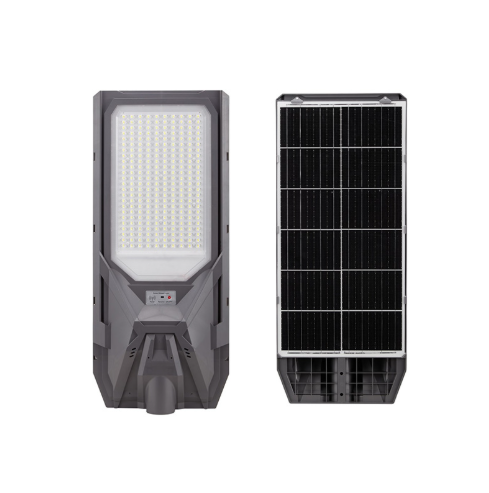
Our product connects naturally to this topic because it is built as an exterior solar street light for urban and rural streets. That means it is already positioned for practical road lighting use rather than decorative lighting only. It uses solar power instead of traditional grid dependence, which is valuable for projects that want lower energy cost, easier deployment in remote areas, or a cleaner sustainability message. For wholesalers, project buyers, and solution providers, this makes the product easier to place in municipal upgrades, village roads, new residential developments, and infrastructure projects.
Why Solar Street Light Buyers Care About Height
For solar street light projects, height has an extra layer of importance. A higher pole can improve coverage, but the lighting system still needs to deliver enough brightness at ground level. That means buyers need a balanced approach. They need the right height, the right layout, and a fixture that can maintain dependable operation through weather and daily charge-discharge cycles.
This is one reason many B-end customers care about more than appearance. They worry about whether the light can hold stable performance after installation. They worry about project delays caused by mismatched specifications. They worry about maintenance complaints after delivery. They also worry about whether one supplier can support repeat bulk orders with stable quality.
Our solar street light is useful in this discussion because it is designed around practical outdoor use. It uses monocrystalline silicon solar panels, lithium iron phosphate battery configuration, time control, and IP66 protection. It is intended for outdoor conditions and for roads that need dependable lighting without relying fully on conventional power systems. That gives project buyers a more workable base when they are planning height, spacing, and long-term operation together.
How Buyers Usually Decide The Right Height
In most real procurement cases, buyers do not start with one fixed pole height and force every road to use it. They usually begin with the road type and the project goal. A narrow road with slower traffic may need a lower and more comfortable lighting scale. A broader road may need taller mounting for wider coverage. If the project wants to reduce pole quantity, height and spacing often need to be reviewed together. If glare control is important near homes or mixed-use streets, the buyer may prefer a more moderate height and a better-controlled distribution pattern.
This is where supplier support matters. A reliable supplier should help customers think through the application, not just quote a lamp. For importers and contractors, this is a real pain point in the market. Some suppliers offer basic pricing but very little practical guidance. That makes it harder for the buyer to build the right solution, especially when the order is tied to a tender, development project, or distributor channel.
Why Supplier Capability Matters In Road Lighting
Street lighting projects are not simple shelf-item purchases. They often involve layout planning, environmental conditions, delivery timing, and long-term maintenance expectations. That is why many professional buyers look for more than a factory price. They want a supplier that can support OEM and ODM cooperation, understand project use, and keep product consistency across multiple orders.
Our product line fits that supplier logic well. It is not just a lamp for display. It is a solar road-lighting option that can be used in real exterior environments, with time control, weather-resistant protection, and solar-powered operation. For buyers building their own brand or bidding into local projects, OEM and ODM support adds another layer of value. It gives more room for product positioning, specification matching, and market adaptation.
Conclusion
So, how high are street lights? In practice, they are usually installed at different heights depending on where they are used. Smaller pedestrian and low-scale street lighting may be around 4.5 to 6 meters. Many standard streets fall around 8 to 10 meters. Wider roads often move toward 10 to 12 meters. The right answer depends on the road, the spacing plan, the fixture performance, and the lighting goal.
That is why street light height should never be treated as a simple number alone. It should be part of a complete lighting decision. A well-matched solar street light can help improve coverage, reduce operating pressure, and make project delivery more efficient. If you are planning a road lighting project and want advice on fixture selection, application matching, or OEM and ODM cooperation, contact us for practical guidance. We can help you review a more suitable solar street lighting direction for your market and project needs.
Previous: