

How Far Apart Are Street Lights?
Determining how far apart street lights should be placed is one of the most important considerations in roadway design, public safety engineering, and illumination planning. Proper spacing affects visibility, uniformity, energy use, and installation cost, which is why urban planners, contractors, and developers rely on established lighting principles rather than random placement. The distance between poles is not identical across all roads; instead, it changes based on road width, mounting height, traffic flow, surrounding brightness, and the optical performance of the chosen fixture. With advanced LED luminaires such as FEIDONG’s engineered LED Street Light, spacing principles have become more flexible, allowing wider intervals without compromising illumination quality. Understanding this spacing requirement helps municipal managers and private developers design safer and more energy-efficient streets.
1. Understanding the Purpose of Street Light Spacing
The question of how far apart street lights should be installed begins with understanding why spacing matters at all. Street lighting is not simply about placing lamps along the roadside—its purpose is to ensure continuous visibility, minimize dark zones, and provide uniform lighting distribution across pedestrian paths and vehicle lanes. If spacing is too wide, dark patches appear between poles, creating shadows that can affect safety. If spacing is too tight, energy is wasted and unnecessary brightness causes glare or light pollution. Achieving the correct balance is therefore fundamental to roadway engineering.
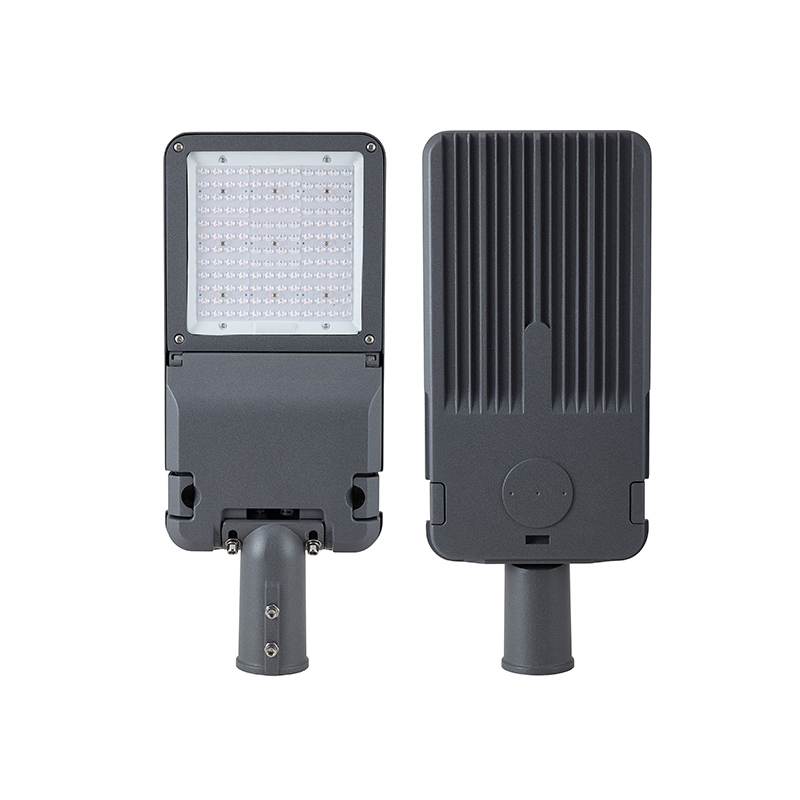
Proper spacing guidelines originate from photometric principles. A luminaire does not cast light uniformly forward but distributes it across a calculated spread shaped by lenses and reflectors. Modern LEDs, especially luminaires like FEIDONG’s LED Street Light, use precision optical modules that direct light where it is needed, allowing planners to widen spacing while maintaining the desired uniformity ratio. This is particularly important because each road classification has a different illumination requirement. For instance, highways prioritize long-range visibility for fast-moving vehicles, while residential streets emphasize comfort lighting for slower traffic and pedestrian safety.
Urban design also influences spacing decisions. Areas with heavy ambient lighting from commercial zones or building façades may require fewer poles, while rural regions lacking background brightness rely solely on the installed lighting system. Road width affects spacing as well, because a broader street requires more lateral spread from each luminaire. In addition, pole height becomes a central factor: the higher the pole, the wider the spacing can be. These relationships form the foundation of street lighting design, enabling planners to determine the correct intervals to meet safety standards and illumination goals.
2. Typical Spacing Ranges in Modern Roadway Lighting
While spacing must be calculated for each project individually, the lighting industry follows standardized ranges that serve as practical guidelines. These ranges are not arbitrary—they result from decades of roadway illumination research, engineering standards, and government safety requirements. Although different countries may use slightly different standards, most align closely due to similar photometric principles.
The following table summarizes typical spacing intervals for common roadway types using modern LED Street Lights:
Typical Street Light Spacing Guidelines
| Road Type | Pole Height | Typical Spacing Range |
|---|---|---|
| Residential Roads | 6–9 m | 25–35 m |
| Collectors / Secondary Roads | 9–12 m | 30–45 m |
| Main Arterial Roads | 10–12 m | 35–50 m |
| Highways / Expressways | 12–15 m | 45–60 m |
| Industrial Roads | 10–12 m | 30–50 m |
| Pedestrian Paths | 4–6 m | 15–25 m |
These values are approximate but reflect the most commonly used spacing intervals worldwide. The ranges also demonstrate that LED systems tend to support wider spacing compared with legacy high-pressure sodium or metal halide lamps. This is because LEDs deliver higher uniformity and stronger forward throw, reducing the need for tightly spaced poles.
Spacing also depends on whether the installation uses single-sided, opposite-sided, or staggered layouts. In a single-sided configuration, spacing is often shorter because all illumination originates from one side of the road. Opposite-sided layouts allow poles to be placed farther apart because the light overlaps more effectively. Staggered layouts offer the best coverage in many large-road applications because alternating placement minimizes dark zones while maximizing uniformity.
Planners also consider glare control and luminance ratios. A pole set too close may cause excessive brightness in the driver’s direct line of sight, while poles set too far apart may create abrupt changes in brightness. LED optics in FEIDONG’s LED Street Light help reduce such issues through optimized beam angles and carefully designed lens structures, enabling smoother transitions from pole to pole.
3. How Pole Height Influences Street Light Spacing
Pole height and spacing share a direct relationship: as pole height increases, the effective coverage area increases as well, permitting lights to be installed farther apart. This principle applies across residential, commercial, and highway installations. A luminaire mounted at 6 meters will illuminate a far smaller portion of the road compared with one mounted at 12 meters. This expansion occurs because the light beam disperses wider from a greater elevation, reaching deeper into the road and providing overlapping illumination patterns.
However, higher mounting heights do not automatically guarantee better lighting. Beyond a certain point, raising the pole height can reduce lighting uniformity because the light may disperse too broadly, leading to insufficient ground illuminance. Additionally, excessive height may increase glare because the luminous source sits closer to the driver’s line of sight. This is why professional photometric planning is essential, particularly when designers attempt to maximize spacing.
To better understand the relationship between mounting height and spacing, consider the following common ratios used in the lighting industry:
Spacing ≈ 3 to 4 times the mounting height
Example: A 10-meter pole often supports spacing between 30 and 40 meters.Spacing decreases slightly on narrow roads
Narrower roadways require higher uniformity, which means planners shorten spacing.Spacing increases on multi-lane roads
Wider road surfaces allow more horizontal light spread, pushing spacing to the upper limits.
Modern LED optics significantly enhance the usable spread of light, meaning a 10-meter pole equipped with a high-quality LED luminaire can cover more area compared with legacy technologies. FEIDONG’s LED Street Light incorporates lens arrays calibrated for wide-beam roadway illumination, allowing installations to achieve longer spacing without losing uniformity.
Another important variable is the tilt angle. Even a slight change in the tilt of a luminaire dramatically alters its coverage area and effective spacing. Too much tilt can increase glare, while insufficient tilt may cause inadequate forward illumination. Contemporary LED drivers and mounting brackets allow precise adjustments, helping planners maintain optimal spacing configurations.
4. Environmental and Roadway Factors That Affect Spacing
Spacing is not determined solely by the pole height, road width, or luminaire wattage. Real-world conditions often shape the final placement of fixtures. Road geometry, atmospheric conditions, terrain, and the surrounding environment can all influence spacing requirements. Professional planners consider these environmental variables to ensure both safety and visual comfort.
One of the most prominent factors is road width. A wide, multi-lane road demands more lateral light distribution, which often requires either specialized optical lenses or a closer pole spacing. Conversely, a narrow residential street needs less lateral spread, enabling wider spacing even with moderately powered fixtures. Traffic flow also affects spacing, as high-speed roads require brighter and more uniformly distributed light to extend reaction time for drivers.
The reflectivity of the road surface can impact how far the illumination effectively travels. Surfaces with high reflectance, such as light-colored concrete, increase perceived brightness and allow for slightly wider spacing. Dark asphalt absorbs more light and may require a narrower interval. Similarly, areas with heavy ambient brightness—near commercial plazas or illuminated buildings—can tolerate wider spacing because the environment supplements the installed lighting system.
Natural obstacles influence pole placement as well. Tall trees, road curvature, pedestrian crossing zones, and slopes can diminish illumination levels, requiring planners to adjust spacing to prevent shadows. Weather also matters: fog-prone regions may utilize narrower spacing to counteract dispersion and maintain visibility.
With modern led street lights, many of these environmental challenges are easier to manage. Precision optical control helps maintain coverage uniformity despite complex surroundings. FEIDONG’s LED Street Light is designed with multiple beam-angle choices, allowing lighting designers to match the luminaire to environmental demands without compromising spacing efficiency.
5. Modern LED Optics and Their Impact on Wider Spacing
Advancements in LED street lighting have changed the way engineers think about spacing. Traditional light sources relied heavily on reflectors, which often caused scattered illumination and inefficient light distribution. LED architectures, on the other hand, utilize specialized lenses and optical modules that shape light with high precision. This expanded ability to control the beam allows planners to space poles farther apart while maintaining uniform brightness on the ground.
Modern LED luminaires achieve this through various design features. Optical lenses bend light in specific patterns that match roadway profiles, sending more light forward and sideways rather than wasting it upwards. Multi-layer lens technology can fine-tune the beam to extend effective throw distance, enabling fewer poles along long stretches of roadway. Light-loss factors are lower with LED systems, meaning planners can confidently rely on simulated spacing values because LEDs do not degrade rapidly during warm-up or over time.
Additional improvements come from higher lumen-per-watt performance. Since LEDs generate more visible illumination per watt, fewer luminaires are needed to achieve comparable brightness. This reduces installation cost, maintenance, and energy usage while supporting longer spacing. Thermal stability also plays a role: efficient heat dissipation maintains consistent optical output, preventing brightness drop-off that could otherwise require closer pole placement.
Because FEIDONG integrates optimized optical modules and high-lumen chips into its LED Street Light series, these luminaires support advanced photometric configurations. This allows lighting planners to allocate spacing flexibly based on project goals. Whether the requirement is for uniform pedestrian lighting or long-throw highway illumination, LED optics enable intelligent, cost-effective spacing strategies.
Summary
Street light spacing is a calculated aspect of roadway illumination design that balances safety, visual comfort, uniformity, and energy efficiency. While general guidelines help determine average spacing ranges, exact distances depend on road width, mounting height, optics, and environmental influences. With LED lighting becoming the global standard, spacing strategies are evolving to maximize efficiency while maintaining high-quality illumination.
Because LED light engines deliver directional and precise illumination, poles can be spaced farther apart compared with traditional lamps. This contributes to reduced infrastructure costs and improved long-term energy management. FEIDONG’s engineered LED Street Light line is designed to support these modern spacing principles, offering stable optical performance, multiple beam-angle options, and high lumen output for diverse roadway types.
By understanding the interplay between height, optics, environment, and photometric goals, planners can design lighting networks that keep roads safe, comfortable, and visually consistent. Whether the project involves residential streets, commercial districts, or large highways, determining the correct street light spacing remains a foundational step toward building reliable and efficient urban infrastructure.